
Traction Battery Buying Guide
How to Choose the Right Traction Battery
For most traction applications, choosing the right battery starts with the equipment already in use. Match the manufacturer's specification or existing battery bank first, then consider changing capacity or battery technology only where there is a clear operational benefit.
Check the existing battery voltage, capacity, dimensions, terminal arrangement, quantity and charging system. For golf carts, industrial cleaning machines, airport vehicles, utility EVs and other electric equipment, like-for-like replacement is normally the safest starting point.
What Are You Replacing?
Start with the battery already fitted. Most traction replacements fall into one of these routes.
Start With the Existing Battery Specification
Traction batteries are primarily a fitment and duty-cycle decision. If the existing battery system has performed correctly, replacing it with the same electrical and physical specification is normally the lowest-risk route.
Voltage
Match the voltage of each battery. Do not substitute 6V and 12V batteries without redesigning the complete battery bank.
Capacity
Check the Ah rating and the discharge rate it is stated at. Capacity affects runtime, but a higher Ah figure alone does not confirm compatibility.
Dimensions
Check length, width and total height. Traction batteries can have similar capacities while using different case formats.
Terminals
Confirm terminal type, position and existing interconnects before ordering a replacement bank.
Battery Quantity
Count the batteries in the bank. The number of batteries and the way they are connected determine the complete system voltage and capacity.
Charger
If changing battery technology, confirm that the existing charger has a suitable charging profile before making the change.
Use matched batteries of the same model, capacity and age. Avoid mixing new batteries with older units in the same battery bank.
6V Flooded Traction Batteries: Leoch DT Range
The Leoch DT range is the straightforward option where a serviceable flooded deep-cycle battery is already specified and there is no operational reason to move to a maintenance-free technology.
These batteries are designed for repeated cyclic use in applications such as golf carts, electric vehicles, cleaning equipment and other traction machinery.
Leoch DT106
The 225Ah option in the DT family. Choose it where the existing equipment specification, battery bank and physical fitment require this capacity.
View DT106 6V 225AhLeoch DT126
The 240Ah DT option. Suitable where this capacity is already specified or where a change from another capacity has been technically confirmed.
View DT126 6V 240AhThe highest-capacity model in this DT group. It is intended for higher-capacity 6V traction fitments, but should not be selected purely because 260Ah is the largest number. Confirm the equipment specification and physical fitment first.
View DT146 6V 260AhStart with the capacity specified by the equipment manufacturer or the battery already fitted. DT106, DT126 and DT146 provide different capacities within the 6V flooded traction family, but higher capacity should not automatically be treated as a better replacement.
When Does LDC Lead Carbon Make Sense?
LDC Lead Carbon is the main alternative where the customer wants to move away from conventional serviceable flooded batteries or replace another sealed traction technology with a more competitively priced maintenance-free option.
LDC Lead Carbon is particularly useful where equipment is cycled frequently, opportunity-charged or operated for periods without always returning to a complete state of charge.
No Water Top-Ups
LDC removes the routine electrolyte maintenance associated with serviceable flooded traction batteries.
PSOC Operation
Lead Carbon is well suited to applications where equipment frequently operates at partial state of charge between working periods.
Charge Acceptance
Improved charge acceptance can make LDC useful for commercial equipment operating around repeated work and charging windows.
Commercial Value
LDC can provide a strong price-to-performance option where a maintenance-free traction battery is required.
6V LDC Lead Carbon Options
| Model | Voltage | Capacity | Format | Selection Role |
|---|---|---|---|---|
| LDC6-210-GC2 | 6V | 210Ah C20 | GC2 | Lower-capacity GC2 Lead Carbon fitments. |
| LDC6-224-GC2 | 6V | 224Ah C20 | GC2 | Common-capacity GC2 Lead Carbon applications. |
| LDC6-245 | 6V | 245Ah C20 | DIN | DIN-case traction fitments requiring a different physical format. |
| LDC6-265-GC2 | 6V | 265Ah C20 | GC2 | Higher-capacity GC2 Lead Carbon fitments. |
Before changing from flooded or Gel to Lead Carbon, confirm battery dimensions, terminal arrangement, total bank voltage, required capacity and charger compatibility.
Should I Replace a Refillable Flooded Traction Battery?
Not automatically. If your equipment already uses a high-quality refillable flooded traction battery and it is being correctly charged, topped up and maintained, like-for-like replacement can remain the strongest option for maximum service life.
Keep Flooded Where Maintenance Is Not a Problem
A properly maintained industrial flooded traction battery is extremely difficult to beat in heavy cyclic use.
LDC becomes more attractive when the operational priority is reduced maintenance, no routine water top-ups, sealed construction or stronger partial-state-of-charge capability.
This is particularly relevant to commercial fleets. A battery with excellent potential service life only delivers that value when the required maintenance and charging regime are consistently followed.
Replacement Batteries for Industrial Cleaning Machines
Industrial floor scrubbers, sweepers and cleaning machines commonly use sealed traction batteries. If your machine currently uses a Gel battery such as Sonnenschein, you do not necessarily need to replace it with another Gel battery.
Check Whether Leoch LDC Lead Carbon Is Compatible
Battery Store does not currently offer a Leoch Gel traction range. Instead, where the electrical specification, physical dimensions and charging system are compatible, we recommend comparing the existing Gel battery with the Leoch LDC Lead Carbon range.
LDC offers maintenance-free operation, strong cyclic performance, good partial-state-of-charge capability and a highly competitive purchase price for commercial cleaning equipment.
Send us the exact battery model number or a clear photograph of the label. We can compare the voltage, capacity, dimensions, terminals and bank configuration against the LDC range and advise whether there is a suitable Lead Carbon alternative.
Where an LDC replacement is compatible, the main commercial advantage is often purchase cost and maintenance-free operation. Expected service life will still depend on the machine, depth of discharge, charging pattern and operating conditions.
The charger must also be suitable for the replacement battery technology. If you are unsure, provide the machine model, existing battery model and charger information before ordering.
Golf Carts, Airport Vehicles & Industrial EV Batteries
The same selection process applies across golf carts, airport ground-support vehicles, electric utility vehicles, off-road EVs and other battery-powered industrial equipment: identify the complete battery bank before choosing individual batteries.
Golf Carts & Golf Buggies
Check total system voltage, number of batteries, individual battery voltage and existing capacity before replacing the bank.
Airport Vehicles
For airport and ground-support equipment, provide the vehicle model and existing battery specification. Duty cycle and available charging time can help determine whether flooded or LDC is the better fit.
Utility & Off-Road EVs
Replacement should be based on the complete bank specification rather than choosing an individual battery by Ah alone.
Industrial Equipment
Cleaning machines, access equipment and other cyclic machinery may suit either direct replacement or a technology change depending on fitment and operating requirements.
If multiple vehicles use the same battery bank, send us one complete specification. We can assess the replacement requirement across the fleet rather than treating every vehicle individually.
How Many 6V Batteries Does My Vehicle Need?
In a series-connected traction bank, the voltages add together while the Ah capacity remains the same.
| System Voltage | Using 6V Batteries | Example |
|---|---|---|
| 24V | 4 × 6V batteries | 4 × 6V 225Ah = 24V 225Ah |
| 36V | 6 × 6V batteries | 6 × 6V 225Ah = 36V 225Ah |
| 48V | 8 × 6V batteries | 8 × 6V 225Ah = 48V 225Ah |
Eight 6V 225Ah batteries connected in series create a 48V 225Ah bank, not a 48V 1800Ah bank.
Before Changing Battery Technology or Capacity
A traction battery change should solve a real problem. If the existing system performs correctly, like-for-like replacement is usually the simplest option.
Check These Before Changing the Existing Specification
| Check | Why It Matters |
|---|---|
| Individual battery voltage | Must work with the existing battery-bank configuration. |
| Total system voltage | Must remain correct for the vehicle or equipment. |
| Capacity / Ah | Affects runtime and charging requirements. |
| Length, width & height | The replacement must physically fit the existing battery compartment or tray. |
| Terminal arrangement | Existing cables and interconnects must connect correctly. |
| Battery quantity | Determines the complete battery-bank configuration. |
| Charger profile | Especially important when changing between flooded, Gel and Lead Carbon technologies. |
| Duty cycle | Frequent cycling, opportunity charging and PSOC operation can change which technology makes most sense. |
Traction Battery FAQs
How do I choose the correct traction battery?
Start with the manufacturer's specification or the batteries already fitted. Match voltage, capacity, dimensions, terminals, quantity and bank configuration. If changing battery technology, also confirm charger compatibility.
Can I replace a flooded traction battery with Lead Carbon?
Potentially. LDC Lead Carbon can be a useful maintenance-free alternative to conventional flooded batteries, particularly where reduced maintenance, frequent cycling or PSOC operation are important. Physical fitment, capacity, system voltage and charging compatibility must still be confirmed.
Is Lead Carbon better than a flooded traction battery?
Not in every application. A properly maintained refillable flooded traction battery can provide exceptional service life. Lead Carbon becomes more attractive where maintenance reduction, sealed construction, charge acceptance or partial-state-of-charge performance are higher priorities.
Can I replace a Gel cleaning-machine battery with Lead Carbon?
In many cases there may be a compatible LDC Lead Carbon alternative, but it should not be selected by Ah rating alone. Match voltage, capacity, dimensions, terminals and bank configuration, then confirm the charger is suitable for the replacement battery technology.
Can LDC replace a Sonnenschein Gel battery?
Potentially. Send us the exact Sonnenschein model number or a photograph of the battery label. We can compare the specification against the available LDC range and confirm whether a suitable Lead Carbon replacement is available.
Why choose LDC instead of another Gel battery?
Where compatible, LDC can provide a maintenance-free cyclic battery with strong PSOC capability at a highly competitive purchase price. It can therefore be a strong value option for industrial cleaning equipment and other commercial traction applications.
Should I replace the complete traction battery bank?
Normally, yes. Batteries connected together in a traction bank should be matched in model, capacity and condition. Mixing new batteries with significantly older units can create imbalance and limit the performance of the complete bank.
Can I fit a higher Ah traction battery for more runtime?
Sometimes, but higher Ah is not automatically an upgrade. Confirm physical fitment, battery weight, terminal arrangement, charging requirements and equipment compatibility before changing capacity.
What does PSOC mean?
PSOC means Partial State of Charge. It describes operation where the battery is repeatedly used without always returning to a full charge. This is common in commercial equipment that is opportunity-charged between working periods and is one of the operating conditions where Lead Carbon can be particularly useful.
How many 6V batteries are needed for a 48V golf cart?
A conventional 48V series bank using 6V batteries requires eight batteries. Eight 6V 225Ah batteries connected in series create a 48V 225Ah battery bank.
How many 6V batteries are needed for a 36V golf cart?
A conventional 36V series bank using 6V batteries requires six batteries. Six 6V 225Ah batteries connected in series create a 36V 225Ah battery bank.
Do traction batteries need a special charger?
The charger must be suitable for the total battery-bank voltage, battery technology and charging requirements. This is particularly important when changing away from the technology originally specified by the equipment manufacturer.
What battery do I need for an airport or industrial electric vehicle?
Identify the vehicle model and complete existing battery-bank specification first. For fleet applications, also consider the duty cycle and charging pattern, as these can help determine whether conventional flooded or maintenance-free Lead Carbon is the more suitable replacement.
Replacing Batteries Across a Fleet?
For golf fleets, industrial cleaning equipment, airport vehicles, utility EVs and other commercial traction applications, you do not need to identify the replacement battery yourself.
Send Us the Existing Battery or Vehicle Specification
For a direct replacement, send us the existing battery model, voltage, Ah rating, dimensions and quantity per vehicle.
If you are considering a technology change, also tell us how the equipment is used and charged. We can compare the existing fitment against the Leoch DT and LDC ranges rather than simply recommending the closest Ah figure.
UK battery support: 01858 456 668 | Monday–Friday, 8:30–17:30
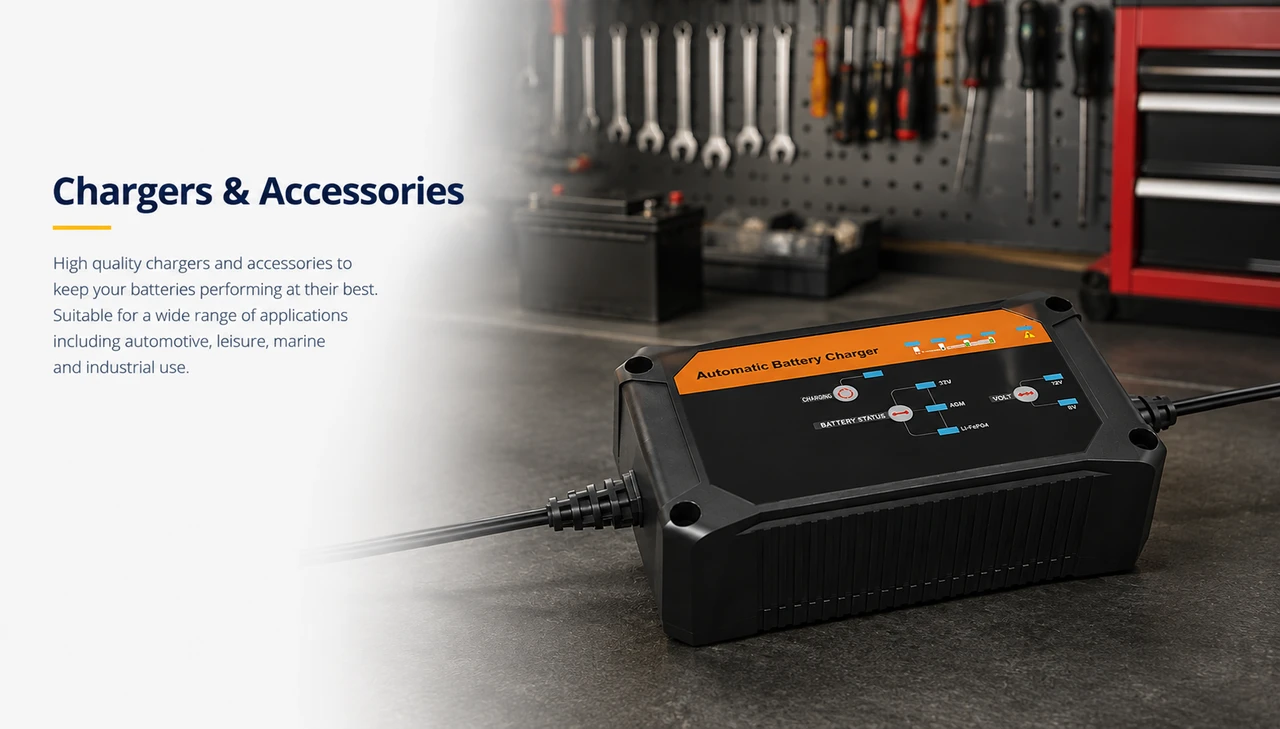
Chargers & Accessories
High-quality chargers and accessories to keep your batteries performing at their best. Suitable for a wide range of applications including automotive, leisure, marine and industrial use.
There are no products listed under this category.