
Off-Grid Battery Buying Guide
How to Choose an Off-Grid Battery
Off-grid battery requirements can vary enormously. A battery running an electric fence or clay pigeon trap has very little in common with a 48V solar energy-storage system powering a remote building. The important questions are what you need to power, how much energy it uses, how long it needs to run, how the battery will be recharged and whether you are building a simple 12V system or a larger battery bank.
Just Tell Me What You're Powering
Pick the option that sounds most like your application and jump straight to the most sensible battery route.
- Application: what equipment will the battery actually power?
- Daily energy use: how many watts does the equipment consume and how long does it operate each day?
- Runtime: how long must the system operate without meaningful recharge?
- System voltage: are you working with 12V, 24V, 48V or another voltage?
- Charging: solar, mains, generator or a combination?
- Technology: flooded, AGM, Lead Carbon and lithium suit very different usage patterns.
- Physical space: check battery dimensions, quantity, total weight and mounting area.
Best Battery for Electric Fencing & Clay Pigeon Traps
Not every off-grid application needs an expensive deep-cycle energy-storage battery. Electric fencing, clay pigeon traps and similar intermittent 12V equipment can often be powered perfectly well by a straightforward flooded leisure battery.
If the duty is relatively light and the battery can be recharged normally, there is often very little reason to spend additional money on AGM, Lead Carbon or lithium.
Leoch SFL-85 12V 85Ah Flooded Leisure Battery
The SFL-85 is our straightforward recommendation for simple applications where the priority is dependable 12V power without paying for cycling performance that the application does not need.
It is particularly well suited to applications such as electric fencing and clay pigeon traps, where the battery typically spends much of its time supplying a relatively modest intermittent load.
If the application is simple and lightly cycled, keep the battery simple too. Paying substantially more only makes sense when the usage pattern actually benefits from the upgrade.
When Does AGM Make Sense for Off-Grid Use?
AGM becomes more attractive when the battery is used more regularly but the installation still revolves around a conventional standalone 12V battery rather than a large energy-storage bank.
Typical examples include off-grid lighting, temporary event systems, mobile displays, screen installations and other auxiliary equipment where the battery is discharged and recharged more frequently.
Leoch LAGM-130
A useful general-purpose AGM option where you need more regular cyclic capability than the standard flooded range but do not need to construct a large industrial battery bank.
Leoch LAGM-160
A higher-capacity AGM option where the application needs more energy per battery while remaining within a conventional 12V format.
Once the application becomes a large solar bank, is cycled heavily every day or spends substantial time at partial state of charge, we would normally move beyond standard leisure AGM and look toward Lead Carbon or lithium.
What Size Off-Grid Battery Bank Do I Need?
This is the point where off-grid battery selection becomes application-specific. There is no single Ah capacity that is right for every off-grid system.
A better starting point is to calculate the amount of energy your equipment consumes in watt-hours (Wh).
Daily energy use in Wh = appliance wattage × hours used per day
Calculate this for each electrical load and add the figures together.
Example: 60W Load Running for 8 Hours
A 60W load running for eight hours consumes:
If you need two days of autonomy before meaningful recharge, the loads alone require approximately 960Wh of energy before allowing for usable depth of discharge, conversion losses, temperature and reserve capacity.
What Does "Days of Autonomy" Mean?
Autonomy is how long the system needs to continue operating without useful charging.
Daily Solar Recharge
If the battery receives reliable charging every day, the storage requirement may be relatively modest.
Variable Solar
If cloud, shading or winter conditions can reduce solar generation, more reserve capacity may be required.
Generator Backup
Reliable generator backup can reduce the amount of battery autonomy you need to build into the system.
No Reliable Backup
Remote systems that must operate continuously may need several days of stored energy rather than simply one day's consumption.
Battery technology, depth of discharge, discharge rate, temperature and the desired service life all influence how much of the stated capacity should routinely be used. Size the complete system rather than simply matching nominal Wh to daily consumption.
Should My Off-Grid System Be 12V, 24V or 48V?
Small systems commonly use 12V because the equipment is simple and widely available. As inverter power and total energy requirements increase, moving to a higher system voltage becomes increasingly useful.
For the same electrical power, a higher system voltage means lower current. This reduces the extremely high current levels that otherwise appear in powerful 12V systems.
| System Voltage | Typical Use | Battery Approach | Our View |
|---|---|---|---|
| 12V | Small off-grid systems and standalone equipment | Single 12V battery or 2 × 6V batteries in series | Simple and practical for relatively modest loads. |
| 24V | Medium off-grid systems | 4 × 6V batteries in series or another compatible 24V bank | Becomes increasingly useful as inverter demand rises. |
| 48V | Large solar and energy-storage systems | 8 × 6V batteries in series or 51.2V LiFePO4 ESS modules | The architecture we would investigate first for a substantial modern off-grid system. |
System voltage should be chosen around the complete installation including the inverter, solar controller, charger, DC loads and battery bank. Do not choose battery voltage independently of the equipment it needs to operate with.
Best Non-Lithium Battery for Solar & Heavy Off-Grid Cycling
For a serious solar installation, remote power system or other application where the battery bank is cycled heavily, the requirement changes again.
Solar systems can spend substantial periods at partial state of charge (PSOC) because generation and electrical consumption vary continuously. The batteries may therefore be repeatedly discharged and partially recharged rather than returning immediately to a complete full charge.
This is where the Leoch LDC Lead Carbon range becomes particularly relevant.
Leoch LDC Lead Carbon
LDC Lead Carbon batteries are designed for demanding cyclic operation and offer improved charge acceptance and partial-state-of-charge performance compared with conventional flooded batteries.
For customers building a serious non-lithium off-grid or solar storage system, this is the battery technology we would investigate first.
6V 210Ah vs 6V 400Ah Lead Carbon
The correct model depends on the total capacity required and the physical design of the battery bank. The advantage of the 6V format is that identical batteries can be connected in series to create the required system voltage.
Leoch LDC6-210-GC2
A compact 6V Lead Carbon option for building 12V, 24V or 48V cyclic banks where the 210Ah capacity suits the system requirement.
Leoch LDC6-400-L16
A substantially larger 6V 400Ah Lead Carbon battery designed for heavy-duty energy storage. Its high capacity makes it particularly useful where a serious 24V or 48V non-lithium battery bank is required.
How Do 6V Batteries Build a 12V, 24V or 48V Bank?
When identical batteries are connected in series, their voltages add together while the Ah capacity remains the same.
2 × 6V 210Ah
Connected in series:
12V • 210Ah • 2.52kWh nominal
4 × 6V 210Ah
Connected in series:
24V • 210Ah • 5.04kWh nominal
8 × 6V 210Ah
Connected in series:
48V • 210Ah • 10.08kWh nominal
8 × 6V 400Ah
Connected in series:
48V • 400Ah • 19.2kWh nominal
They do not represent guaranteed usable energy. Actual usable capacity depends on discharge depth, load, charging regime, temperature, battery condition and how the bank is operated.
What Happens When Batteries Are Connected in Parallel?
Parallel connection increases Ah capacity while keeping the system voltage the same.
For example, two correctly connected compatible 12V 130Ah batteries in parallel provide approximately 12V 260Ah nominal capacity.
Large banks should be designed so that current is distributed evenly, batteries remain correctly matched and the cabling and protection equipment are suitable for the maximum possible current.
48V Lead Carbon vs 48V Lithium Energy Storage
Once the application becomes a substantial 48V system, it is more useful to compare complete bank architectures than individual battery capacities.
8 × LDC6-400-L16
Eight 6V 400Ah LDC batteries connected in series create a substantial 48V 400Ah Lead Carbon storage bank with approximately 19.2kWh of nominal energy.
Leoch LFeLi-48100
The LFeLi-48100 is a 51.2V 100Ah rack-mounted LiFePO4 battery specifically designed for energy storage, PV off-grid backup power and compatible 48V-class systems.
Compatible modules can be connected in parallel to increase total stored energy while retaining the same nominal system voltage.
Why modular lithium is attractive: additional compatible 51.2V modules increase storage capacity through parallel expansion rather than requiring a new series string of individual low-voltage batteries.
The current product specification supports up to 16 groups of parallel connections. The inverter, BMS communication, protection equipment and complete system design must still be compatible with the proposed battery quantity.
Correct inverter compatibility, over-current protection, isolation, cable sizing, earthing, BMS configuration and commissioning are critical when working with substantial energy-storage systems.
What Is the Best Battery for Off-Grid Solar?
The best battery for an off-grid solar system depends largely on how frequently the bank is cycled and how consistently the solar array can replace the energy consumed.
A small occasional solar installation may work perfectly well with a conventional flooded or AGM battery. A system being cycled hard every day is a very different proposition.
| Technology | Best Suited To | What You Gain | Our View |
|---|---|---|---|
| SFL Flooded | Simple / intermittent applications | Low upfront cost and straightforward conventional battery technology. | Ideal where the usage pattern does not justify spending more. |
| LAGM AGM | Regular standalone auxiliary power | Sealed construction and stronger cyclic capability than basic flooded leisure batteries. | Useful middle ground for moderate 12V systems. |
| LDC Lead Carbon | Solar / frequent cycling / PSOC | Heavy cyclic design, improved charge acceptance and strong partial-state-of-charge performance. | Our preferred non-lithium route for demanding off-grid storage. |
| LiFePO4 | Modern ESS / high usable energy | High usable storage, modular expansion, integrated battery management and dramatically reduced battery count. | Premium route for compatible modern energy-storage systems. |
What Is Partial State of Charge?
Partial state of charge, usually shortened to PSOC, means a battery spends extended periods below a complete full charge.
This is particularly relevant to solar systems because charging availability changes with weather, shading, season and electrical consumption. A heavily used bank may therefore discharge overnight, recharge only partly during the following day and then be discharged again.
That operating pattern is one of the main reasons Lead Carbon becomes more attractive than a conventional flooded leisure battery for demanding off-grid solar use.
Will My Solar Controller Charge the Battery?
The solar controller must provide a suitable charging profile for the battery technology selected.
Flooded
Use charging settings appropriate to the specific flooded battery.
AGM
Check that the controller provides a suitable AGM charging profile and voltage.
Lead Carbon
Follow the charging specification for the specific LDC battery rather than assuming all lead-acid settings are identical.
LiFePO4
Confirm lithium-compatible charging, BMS requirements and inverter compatibility across the complete system.
Does Inverter Size Determine Battery Capacity?
No. Battery capacity and inverter capacity solve different problems.
Battery Capacity
Determines how much energy the system can store and therefore how long the connected equipment can operate.
Inverter Capacity
Determines how much AC power can be supplied at one time and must allow for relevant peak or starting loads.
A system may use relatively little energy over a full day but still need substantial instantaneous current to start a pump, compressor, motor or other high-demand load.
Daily energy consumption determines storage requirements, while maximum simultaneous and starting loads determine how much power the inverter and battery system must be capable of supplying safely.
Check Battery Dimensions, Weight & System Format
Physical installation becomes increasingly important as off-grid systems get larger. A single SFL-85 weighs less than 20kg; a large 48V Lead Carbon bank can contain eight batteries weighing more than 50kg each.
Always calculate the complete bank footprint and total installed weight, not merely the dimensions of one battery.
| Battery | Technology | Capacity | Dimensions (L × W × H) | Weight |
|---|---|---|---|---|
| SFL-85 | Flooded | 12V 85Ah C100 | 269 × 173 × 224mm total height | 17.7kg |
| LAGM-130 | AGM | 12V 130Ah | 330 × 171 × 220mm | Check product page |
| LAGM-160 | AGM | 12V 160Ah | 345 × 172 × 280mm | 41.2kg |
| LDC6-210-GC2 | Lead Carbon | 6V 210Ah C20 | 260 × 180 × 274mm total height | 27.2kg |
| LDC6-400-L16 | Lead Carbon | 6V 400Ah C20 | 295 × 180 × 428mm total height | 54.2kg |
| LFeLi-48100 | LiFePO4 | 51.2V 100Ah / 5.12kWh | 19-inch rack-mounted format — confirm technical datasheet | Confirm technical datasheet |
Eight LDC6-400-L16 batteries weigh approximately 433.6kg before cabling, racking and protection equipment. Large Lead Carbon banks therefore require a structurally suitable installation area as well as sufficient physical space.
Should All Batteries in an Off-Grid Bank Be Matched?
Yes. Batteries operating together should ideally be the same model, technology, capacity and similar age so that they charge and discharge together as consistently as possible.
Avoid mixing flooded, AGM, Lead Carbon and lithium batteries inside the same working battery bank.
For series-connected banks, one weaker battery can affect the performance of the complete string. For parallel banks, differences between batteries can cause uneven current sharing and charging behaviour.
If several batteries have operated together for a significant period, replacing the complete matched set is generally preferable to adding one brand-new battery alongside substantially older batteries.
Off-Grid, Solar & Energy-Storage Battery FAQs
Off-grid systems vary considerably, so these answers are designed to explain the buying decisions that matter most without pretending there is one battery size that suits every application.
What size battery do I need for an off-grid system?
There is no universal off-grid battery size. Calculate how many watt-hours your equipment consumes each day, decide how long the system must operate between meaningful recharges and then size the battery bank around the required usable stored energy.
How do I calculate my daily off-grid energy use?
Multiply the wattage of each device by the number of hours it operates per day. For example, a 60W load running for eight hours consumes approximately 480Wh. Repeat the calculation for every load and add the figures together.
What is the best battery for an electric fence?
For many conventional 12V electric-fence applications, we recommend the Leoch SFL-85. It provides 85Ah capacity at a relatively low purchase cost, and there is generally little reason to pay for a more advanced battery unless the usage pattern requires it.
What battery should I use for a clay pigeon trap?
The SFL-85 is our straightforward choice for a typical compatible 12V clay pigeon trap. Always check the trap manufacturer's voltage and connection requirements before ordering.
Is AGM worth buying for off-grid use?
AGM can be worthwhile for regularly cycled standalone 12V applications such as lighting, events and mobile display systems. For simple intermittent loads, flooded may be sufficient. For much heavier solar cycling, we would normally look toward Lead Carbon or lithium.
What is the best non-lithium battery for off-grid solar?
For demanding solar and frequently cycled applications, the Leoch LDC Lead Carbon range is our preferred non-lithium route. Its cyclic design, improved charge acceptance and partial-state-of-charge performance make it particularly relevant to off-grid solar duty.
What is a Lead Carbon battery?
Lead Carbon is an advanced lead-acid technology designed to improve charging behaviour and cyclic performance, particularly under demanding operating conditions. In our range, LDC batteries are positioned for traction, renewable energy and other heavy cyclic applications.
What does PSOC mean?
PSOC means partial state of charge. It describes a battery spending extended periods below a complete full charge, which is common in solar systems where charging availability changes with weather, season and electrical demand.
Why is partial state of charge important in solar systems?
A solar battery may be discharged overnight and then receive only a partial recharge during a poor-weather day before being discharged again. Batteries designed to cope well with this repeated operating pattern are therefore particularly useful in demanding solar installations.
Should I choose Lead Carbon or lithium for off-grid storage?
Lead Carbon is a strong option where you want heavy-duty cyclic performance while remaining with lead-acid technology. Lithium becomes particularly attractive where high usable energy, lower battery count, modular expansion and a modern 48V ESS architecture justify the additional investment.
Should an off-grid battery system be 12V, 24V or 48V?
Small systems commonly use 12V. As inverter power and total energy requirements increase, 24V and 48V systems become increasingly attractive because the same amount of electrical power can be transferred at lower current. Choose voltage around the complete system rather than the battery alone.
Why do larger off-grid systems often use 48V?
A higher system voltage reduces current for the same electrical power. This becomes particularly useful as inverter and charging power rises because very high current requires heavier cabling and places greater demands on connections and protection equipment.
How many 6V batteries do I need for a 48V bank?
Eight identical 6V batteries connected in series create a nominal 48V battery bank. The Ah capacity remains the same as one battery while the voltage adds together.
What happens to Ah when batteries are connected in series?
The Ah capacity stays the same while voltage increases. For example, four 6V 210Ah batteries connected in series create a 24V 210Ah bank.
What happens when batteries are connected in parallel?
Voltage remains the same while Ah capacity increases. Two compatible 12V 130Ah batteries connected in parallel provide approximately 12V 260Ah nominal capacity.
Can I mix different batteries in an off-grid bank?
We generally recommend using matched batteries of the same technology, model, capacity and similar age. Mixing substantially different batteries can create charging, discharge and balancing problems.
Can I add a new battery to an old battery bank?
It is generally preferable not to add a brand-new battery to a substantially aged bank. Batteries that have operated together for a long period may have significantly different internal characteristics from a new replacement.
How many days of battery storage do I need?
This depends on how reliable your charging source is and how critical the connected loads are. A system with reliable generator backup may need less battery autonomy than a remote solar system expected to continue operating through several days of poor weather.
Does inverter size determine battery capacity?
No. Battery capacity determines how much energy is stored. Inverter capacity determines how much AC power can be supplied at one time. Both must be sized correctly, but they solve different requirements.
Can a small battery run a large inverter?
Not necessarily. A powerful inverter can demand extremely high current from a low-voltage battery bank. The battery, cables, connections and protection equipment must all be capable of safely supplying the required current.
Can solar panels charge flooded batteries?
Yes. A suitable solar charge controller can charge flooded batteries when configured to the charging requirements of the battery being used.
Can solar panels charge AGM batteries?
Yes. Use a solar charge controller that provides a suitable AGM charging profile and charging voltage for the specific battery.
Can solar panels charge Lead Carbon batteries?
Yes. Lead Carbon is particularly relevant to solar applications, but the solar controller must still be configured to the charging requirements of the specific battery.
Can solar panels charge lithium batteries?
Yes, provided the solar controller and wider electrical system are compatible with the LiFePO4 battery. Larger ESS installations may also require compatible inverter communication and BMS configuration.
What happens if my solar panels do not generate enough power?
The battery bank supplies the difference between generation and consumption, causing its state of charge to fall. If poor generation continues for long enough, the batteries may eventually reach their permitted discharge limit unless another charging source is available.
Should I size an off-grid solar system for winter?
If the system must operate reliably throughout the year, seasonal solar generation should be considered. Designing only around ideal summer output can leave a substantial energy shortfall during winter.
How much energy is stored in a 48V 400Ah battery bank?
A nominal 48V 400Ah bank stores approximately 19.2kWh because 48V × 400Ah = 19,200Wh. This is nominal stored energy rather than guaranteed usable energy.
How much energy is stored in a 51.2V 100Ah lithium battery?
A 51.2V 100Ah battery stores approximately 5.12kWh of nominal energy. Compatible modules can be connected in parallel where supported to increase total storage capacity while retaining the same system voltage.
Can I expand a 48V lithium battery bank later?
Modular ESS batteries are often designed specifically for expansion. The Leoch LFeLi-48100 supports up to 16 groups of parallel connections, subject to the manufacturer's installation requirements and compatible inverter and BMS configuration.
Do I need professional installation for a large off-grid battery system?
We strongly recommend professional design and installation for larger ESS systems. High-energy battery banks require correctly specified cabling, protection, isolation, inverter compatibility, earthing, battery configuration and commissioning.
Still Not Sure Which Off-Grid Battery You Need?
You do not need to design the entire system yourself before speaking to us. Off-grid applications are inherently case-by-case, so give us the information that actually determines battery size and we can help narrow the options down.
- What equipment you need to power.
- The wattage of each major electrical load.
- Approximately how many hours per day each load operates.
- Your required system voltage if already known.
- The inverter make, model and power rating if one is installed.
- How the batteries will be charged: solar, mains, generator or a combination.
- Your solar-array size and solar-controller model if known.
- How long the system needs to operate without meaningful charging.
- The available battery-space dimensions: length, width and height.
- Whether you want the lowest-cost suitable solution or are open to AGM, Lead Carbon or lithium.
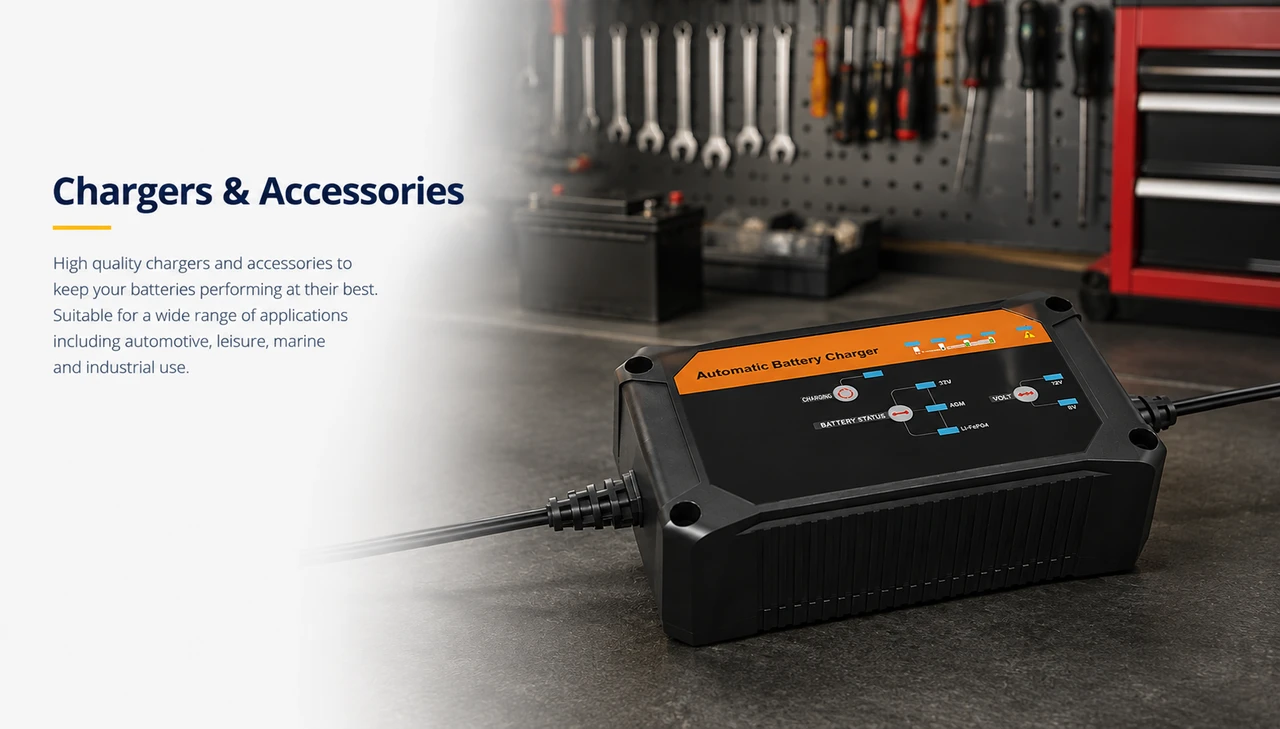
Chargers & Accessories
High-quality chargers and accessories to keep your batteries performing at their best. Suitable for a wide range of applications including automotive, leisure, marine and industrial use.
There are no products listed under this category.