
Marine Batteries
How to Choose a Marine or Boat Battery
Choosing the right battery for a boat starts with one simple question: what does the battery actually need to do? A battery used to start an engine has a very different job from a leisure or house battery bank, while electric propulsion has a completely different set of voltage, current and runtime requirements. For a house bank, the key decisions are capacity, usage intensity, battery technology and charging method.
Just Tell Me Which Marine Battery to Choose
Pick the option that sounds most like your boat and jump straight to our recommendation.
- Application: engine starter, leisure/house bank or electric propulsion?
- Voltage: confirm the voltage of the battery system.
- Capacity: for a house bank, calculate how much Ah you need between charges.
- Cranking: for a starter battery, check the engine's required CCA or MCA where specified.
- Technology: flooded, AGM, Lead Carbon and lithium suit different levels of use.
- Dimensions & terminals: check the battery space and cable arrangement.
- Charging: check solar, shore-power and alternator charging compatibility.
What Battery Do I Need to Start My Boat Engine?
A marine starter battery has one primary job: provide a large burst of current to crank the engine. That is different from a leisure battery, which is designed around repeated discharge and recharge cycles.
Many boats still use relatively straightforward alternator charging systems. Where a conventional flooded battery meets the engine's cranking requirement, there is often little reason to complicate the starter side of the installation.
Leoch SFL-130DT 12V 130Ah Dual Terminal Battery
The SFL-130DT is a useful marine option because it combines a substantial 130Ah capacity with dual terminals and dual-purpose starter/leisure capability.
For a conventional engine-starting installation, it provides a straightforward flooded option without paying for a more expensive cyclic technology where that additional capability is not required.
Ah tells you how much energy the battery stores. It does not replace the need to check the engine's required starting performance. If your engine manufacturer specifies CCA or MCA, use that requirement when choosing.
Choosing a Marine Leisure or House Battery Bank
The house bank supplies the electrical equipment onboard when the engine or shore power is not supplying the load directly. Typical loads include lighting, water pumps, refrigeration, navigation equipment, communications, entertainment systems, heating controls and inverters.
This is where marine battery selection starts to differ significantly from motorhomes and caravans. Boats often have fewer height restrictions around the battery bank, so there is less reason to default to low-profile batteries designed specifically to fit beneath seats or inside restricted vehicle compartments.
That opens up much larger battery formats — including 130Ah, 160Ah, 200Ah and 220Ah options — and can allow a high-capacity bank to be built using fewer individual batteries.
Don't start by asking "how many batteries do I need?" Start with the total capacity and performance you need from the bank, then choose the battery size and quantity that achieves it.
How Much Battery Capacity Does My Boat Need?
Marine leisure battery capacity is normally expressed in amp-hours (Ah). The more electrical equipment you use and the longer you remain away from meaningful charging, the larger the energy reserve you will need.
Energy used in Ah ≈ current draw in amps × hours of use
Estimate the consumption of your main electrical loads between charging periods, add them together and include a sensible reserve.
Remember that nominal Ah is not the same as usable Ah. Battery technology and intended depth of discharge have a major effect on how much of the stated capacity should routinely be used.
Example 12V Marine Battery Banks
A three-battery 220Ah bank may provide more nominal capacity than four smaller batteries, but the larger cases still need to fit the available battery area and be securely supported.
Flooded vs AGM vs Lead Carbon vs Lithium: What Are You Actually Paying For?
There is no reason to pay more for a marine battery unless the additional cost solves a problem or gives you something useful. For a house bank, the main differences are cycle capability, usable energy, weight, partial-state-of-charge performance and purchase cost.
| Technology | Best For | Performance Position | Our View |
|---|---|---|---|
| SFL Flooded | Budget / moderate use | 300+ cycle class | Best when keeping the initial cost of a larger battery bank as low as possible is the priority. |
| LAGM / XR AGM | Regular recreational use | 600+ cycle class | Our recommendation for most regular marine leisure users. |
| LDC Lead Carbon | Heavy cycling / PSOC | 1200+ cycle class | Particularly attractive for demanding house banks, liveaboards and solar-supported systems. |
| LiFePO4 Lithium | Premium / frequent use | 5,000 cycle class | Best where low weight, high usable capacity and maximum long-term cycle capability justify the investment. |
Budget Flooded or AGM for a Marine House Bank?
For a larger marine bank, flooded batteries can keep the initial purchase cost down. For regular recreational use, however, AGM is normally where we would spend the extra money.
Leoch SFL-130DT
A cost-effective 130Ah battery that can make sense where several batteries are required and minimising the initial cost of the complete bank is the main priority.
Leoch LAGM-130
Our preferred starting point for a regular marine AGM bank. It retains the same 130Ah nominal capacity while moving to sealed AGM construction and approximately twice the quoted cycle capability of the SFL flooded range.
Our view: if AGM fits the budget and the charging system is suitable, it is normally the stronger choice for a regularly used recreational marine house bank.
Need More Capacity Per Battery?
This is one of the biggest differences between choosing a battery for a boat and choosing one for a campervan. The LAGM-110LL is specifically useful in motorhomes and caravans because its low-profile case can fit beneath seats. If your boat does not have the same height restriction, there is often little reason to sacrifice capacity simply to use a low-profile case.
Larger 160Ah, 200Ah and 220Ah batteries can therefore become much more attractive for marine house banks. Depending on the available space, they can achieve a large total bank capacity using fewer individual batteries.
160Ah AGM
The LAGM-160 provides more capacity per battery than the 130Ah options while retaining AGM construction. It is particularly useful where the boat has sufficient battery space and you want to increase total bank capacity without immediately moving into the physically larger 200Ah-plus formats.
200Ah vs 220Ah High-Capacity AGM
Leoch XR-3500
A large 200Ah AGM dual-purpose battery for installations where high capacity per battery is more useful than a compact or low-profile case.
Leoch XR-4000
At 220Ah per battery, the XR-4000 allows a substantial 12V house bank to be built using relatively few individual batteries where its larger case can be accommodated.
Four 130Ah batteries provide 520Ah. Three 200Ah batteries provide 600Ah. Three 220Ah batteries provide 660Ah. Larger units can reduce battery count, but measure the complete proposed bank before ordering.
Best Marine Battery for Heavy Cycling & Partial State of Charge
For a liveaboard, serious sailing boat, commercial vessel or heavily used off-grid system, the priorities begin to change. The house bank may be cycled much more frequently and may spend significant periods at partial state of charge (PSOC).
This is where the Leoch LDC Lead Carbon range becomes particularly relevant.
Leoch LDC Lead Carbon AGM
LDC batteries are industrial cyclic batteries designed for substantially heavier use than a conventional leisure battery. Their Lead Carbon construction makes them particularly attractive where batteries are repeatedly cycled without immediately returning to a complete state of charge.
That behaviour is highly relevant to marine applications using solar, where generation and consumption can vary throughout the day and the battery bank may spend extended periods operating below a full state of charge.
Leoch LDC12-115-G31-DT
A compact Lead Carbon option where demanding cyclic performance and PSOC resilience matter more than simply maximising Ah per individual battery.
Leoch LDC12-150-GC12
A higher-capacity Lead Carbon option for installations that need the industrial cyclic characteristics of the LDC range while increasing capacity per battery.
The LDC Lead Carbon batteries highlighted here should be maintained using an appropriate AGM charging profile. Check the settings available on the boat's solar controller, mains charger and other charging equipment.
Should I Upgrade My Boat to Lithium?
Lithium is a much larger technological step than moving from flooded to AGM. It becomes particularly attractive where the house bank is cycled frequently, weight is important, electrical consumption is high or you want to use a much greater proportion of the battery's nominal stored energy.
Nominal Ah alone does not tell the whole story with lithium. The ability to use a much greater proportion of the stored capacity means a lithium bank can provide substantially more usable energy than its Ah figure initially suggests.
At approximately 10kg per battery, lithium can also remove a considerable amount of weight from a multi-battery installation compared with a large lead-acid bank.
Check the shore-power charger, solar controller and alternator charging arrangement. Depending on the installation, lithium-compatible charging equipment or an appropriate DC-DC arrangement may be required.
Will My Existing Boat Charger or Solar Controller Work?
Battery technology and charging system need to work together. Marine installations can have several independent charging sources, so check all of them before changing battery technology.
Shore-Power Charger
Check that the mains charger provides a suitable profile and charging voltage for the battery technology selected.
Solar Controller
Many modern solar controllers provide selectable flooded, AGM and lithium profiles. Check the available settings before assuming the controller needs replacing.
Alternator Charging
A conventional flooded starter battery is often straightforward. If the engine also charges the house bank, check how the two banks are connected and controlled.
Lithium Conversion
Lithium requires particular attention to the alternator charging arrangement, as well as the solar and shore-power charging systems.
Check Battery Dimensions, Weight & Terminals
Marine installations frequently have more freedom than the low-profile battery compartments found in campervans and motorhomes, but physical fit still matters — especially when moving to larger 160Ah, 200Ah or 220Ah batteries.
| Battery | Capacity | Dimensions (L × W × H) | Weight |
|---|---|---|---|
| SFL-130DT | 130Ah | 329 × 171 × 237mm | 25.1kg |
| LAGM-130 | 130Ah | 330 × 171 × 220mm | Check product page |
| LAGM-160 | 160Ah | 345 × 172 × 280mm | 41.2kg |
| XR-3500 | 200Ah | 520 × 209 × 230mm | 60kg |
| XR-4000 | 220Ah | 520 × 240 × 240mm | 65kg |
| LDC12-115-G31-DT | 115Ah | 330 × 173 × 237mm | 31.7kg |
| LDC12-150-GC12 | 150Ah | 327 × 180 × 274mm | 42.2kg |
| LFP12100-H | 100Ah | 306 × 168 × 208mm | 10kg |
Should All Batteries in a Marine House Bank Be Matched?
Batteries operating together in the same bank should ideally be the same model, technology, capacity and similar age so they charge and discharge together as evenly as possible.
Avoid mixing flooded, AGM, Lead Carbon and lithium batteries within the same parallel house bank.
If several batteries have been used together for the same period, replacing the complete matched set is generally preferable to adding one brand-new battery alongside significantly older batteries.
What Battery Do I Need for Electric Boat Propulsion?
Electric propulsion is a separate application from a conventional starter or leisure battery. The propulsion system may operate at a much higher voltage and can place a substantial continuous load on the battery.
That means the battery must be selected against the motor and controller specification, rather than simply choosing the largest Ah rating available.
Leoch LR51.2-100 / LFeLi-48100
A suitable 51.2V LiFePO4 battery can provide a strong solution for compatible electric marine propulsion systems, but voltage is only the first requirement.
The battery must also support the propulsion system's required continuous current, peak current and desired operating time, while the charger must be compatible with the battery.
The current product page identifies the LR51.2-100 as a compact 19-inch rack-mounted battery, but does not expose a reliable dimensional specification in the live listing. Confirm the technical datasheet before specifying it for propulsion installation.
Marine & Boat Battery FAQs
What battery should I use to start my boat engine?
Choose a battery that meets the engine manufacturer's required starting performance and physically fits the installation. For a suitable conventional application, the SFL-130DT is our preferred marine starter option. It measures 329 × 171 × 237mm.
What is the best battery for a boat leisure or house bank?
For most regular recreational marine use, AGM is our default recommendation. Flooded is useful where purchase cost is the priority, Lead Carbon is particularly attractive for heavy cyclic and partial-state-of-charge operation, while LiFePO4 is the premium choice for high usable capacity, low weight and very high cycle life.
Do I need a low-profile leisure battery on a boat?
Only if the battery compartment has a strict height restriction. Marine installations often allow larger battery cases, making higher-capacity 130Ah, 160Ah, 200Ah or 220Ah options more attractive where space permits.
How many batteries do I need for my boat?
Start with the total capacity you need rather than a fixed number of batteries. Then check whether the complete proposed bank physically fits the available battery area.
What does connecting marine batteries in parallel do?
Connecting matched batteries in parallel keeps the system voltage the same while adding their Ah capacities. For example, four 12V 130Ah batteries connected in parallel provide a nominal 12V 520Ah bank.
Is AGM worth the extra cost for a boat?
For most regular recreational users, we think so. AGM provides maintenance-free construction and stronger cyclic performance than the SFL flooded range.
What is a Lead Carbon marine battery?
The Leoch LDC Lead Carbon range is designed for demanding cyclic and partial-state-of-charge applications, making it particularly relevant to heavily used marine house banks.
When should I choose Lead Carbon instead of standard AGM?
Consider Lead Carbon when the house bank is cycled very frequently, spends significant periods at partial state of charge, or is used for demanding liveaboard, sailing, commercial or off-grid applications.
Can solar panels charge my boat batteries?
Yes. Solar can be an excellent charging source for a marine house bank when the array and charge controller are correctly sized and the charging profile matches the battery technology.
Is lithium worth it on a boat?
Lithium becomes particularly attractive where batteries are cycled frequently, weight matters or you want to use a greater proportion of the battery's nominal capacity.
Why would I use a 200Ah or 220Ah battery on a boat?
Larger batteries provide more capacity per unit. The XR-3500 measures 520 × 209 × 230mm, while the XR-4000 measures 520 × 240 × 240mm, so check that the available space can accommodate the larger case before designing the bank around them.
Should all batteries in my boat's house bank be the same?
Yes, wherever possible. Use matched batteries of the same technology, model, capacity and similar age.
What battery do I need for an electric boat motor?
Match the battery to the propulsion system's required voltage, continuous current, peak current and desired runtime. Charger compatibility must also be confirmed.
Still Not Sure Which Marine Battery You Need?
You do not need to work all of this out alone. Marine battery systems vary considerably, so give us the information that actually determines the correct battery and we can help narrow the options down.
- Whether the battery is for engine starting, leisure/house use or electric propulsion.
- The system voltage.
- A photograph or model number of the existing battery or batteries.
- The available battery-space dimensions: length, width and height.
- The number and capacity of batteries currently installed.
- For a starter battery, the engine's required CCA or MCA if known.
- For a house bank, how you use the boat and how long you normally spend away from charging.
- Whether the batteries are charged from solar, shore power, alternator or a combination.
- Whether you want the lowest-cost suitable bank or are open to AGM, Lead Carbon or lithium upgrades.
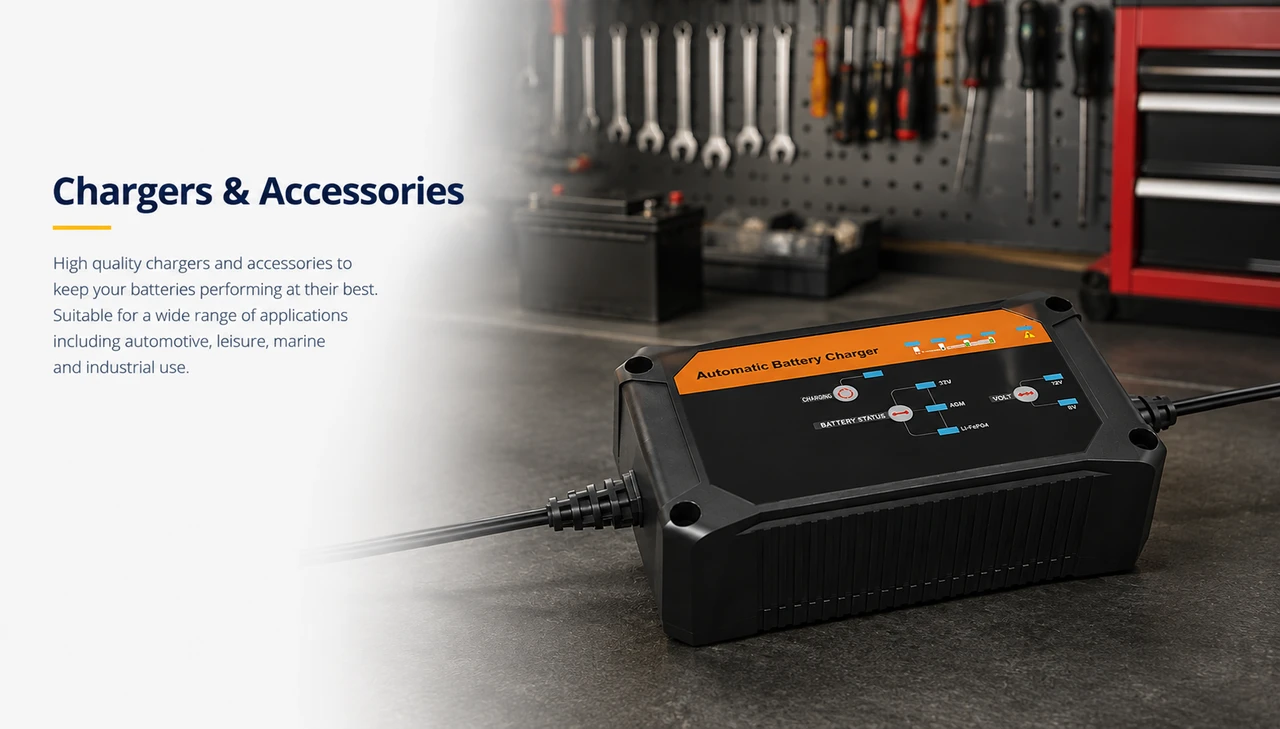
Chargers & Accessories
High-quality chargers and accessories to keep your batteries performing at their best. Suitable for a wide range of applications including automotive, leisure, marine and industrial use.
There are no products listed under this category.