
Battery Charger Buying Guide
How to Choose the Right Battery Charger
Choosing a battery charger is mainly about matching battery voltage, battery technology and battery capacity. Once those three are correct, charger output determines how quickly the battery can be recharged.
First match the charger to the battery voltage — normally 6V, 12V or 24V. Then make sure the charger supports the battery technology, such as standard flooded, AGM, Gel or LiFePO4. Finally, choose a sensible charging current for the size of the battery.
Which Charger Should I Choose?
These three smart chargers cover most common 6V and 12V battery requirements.
1. Match the Charger Voltage to the Battery
Voltage is the first specification to check. The charger must be designed for the voltage of the battery or battery bank being charged.
6V Batteries
Select the charger's 6V setting where supported. The LC-2258, LC-2702 and LC-2259 all provide 6V charging for their supported battery technologies.
12V Batteries
12V is the most common voltage across car, leisure and many other battery applications. All three chargers in this guide support 12V charging.
24V Battery Systems
A 24V battery or 24V bank requires a charging arrangement designed for that system voltage. Do not connect a 12V-only charger across a complete 24V battery bank.
Two 12V batteries connected in series form a 24V bank. A charger connected across the complete bank must be suitable for 24V, even though each individual battery is 12V.
2. Match the Charger to the Battery Technology
A charger should use a charging profile suitable for the battery technology. Do not assume that every charger is suitable simply because the voltage matches.
| Battery Technology | LC-2258 | LC-2702 | LC-2259 |
|---|---|---|---|
| Standard Flooded | Yes | Yes | Yes |
| AGM | Yes | Yes | Yes |
| Gel | — | Yes | — |
| LiFePO4 | Yes | — | Yes |
| Repair Function | — | — | Yes |
For standard flooded or AGM batteries, all three chargers provide compatible options. For Gel batteries, choose the LC-2702. For LiFePO4 batteries, choose the LC-2258 or LC-2259.
3. What Amp Battery Charger Do I Need?
The charger's output current affects how quickly the battery can recharge. In general, a larger battery can make better use of a higher-output charger, while smaller batteries are better suited to lower charging currents.
Match Charging Current to Battery Capacity
For lead-acid batteries, a charging current around 10% of the battery's Ah capacity is a useful general starting point where the battery manufacturer permits it.
That means a 100Ah battery paired with a charger around 10A is a natural combination. It does not have to be exact — a lower-current smart charger can still charge a larger battery, but it will normally take longer.
| Example Battery Capacity | Approx. 10% Charge Rate | Practical Charger Choice |
|---|---|---|
| 20Ah | Approx. 2A | Lower-output smart charging |
| 40Ah | Approx. 4A | LC-2258 4A or suitable selectable output |
| 60Ah | Approx. 6A | LC-2702 6A |
| 100Ah | Approx. 10A | LC-2259 10A |
| 120Ah | Approx. 12A | LC-2702 12A or LC-2259 10A |
Always follow the battery manufacturer's charging limits where specified. Lithium batteries in particular may have charge-current limits determined by the battery and its BMS.
Compare Our 6V & 12V Smart Battery Chargers
LC-2258
A versatile lower-output smart charger for 6V and 12V batteries. Particularly useful where a compact charger is required and charging speed is not the main priority.
View LC-2258LC-2702
Selectable 2A, 6A and 12A output makes the LC-2702 particularly flexible across different lead-acid battery capacities.
View LC-2702LC-2259
The strongest all-round option where a higher charging output is required. Particularly well suited to common 110Ah–130Ah leisure batteries, with additional LiFePO4 compatibility and a battery repair function.
View LC-2259Can I Leave a Smart Battery Charger Connected?
Smart chargers are designed to control the charging process automatically rather than continuously applying maximum charging current.
1. Bulk
The charger supplies charging current to restore the majority of the battery's capacity.
2. Absorption
As the battery approaches full charge, the charger controls the charging process to complete the charge safely.
3. Float
Once fully charged, the charger reduces to a maintenance stage rather than continuing to charge the battery at full output.
No. When used with a compatible battery and in accordance with the charger instructions, a smart charger can automatically manage the charging stages through to float rather than requiring you to guess when the battery has reached full charge.
This makes smart charging particularly useful for vehicles, leisure batteries and equipment that may spend extended periods unused.
Which Charger Should I Use for a Leisure Battery?
Leisure batteries are often much larger than starter batteries, so charger output becomes particularly important if you want to recharge them in a reasonable amount of time.
LC-2259 10A Smart Charger
The LC-2259 is particularly well matched to common 110Ah–130Ah leisure batteries. Its 10A output provides a sensible charging rate while supporting both standard flooded and AGM batteries.
It also supports LiFePO4, making it a useful option where you want one charger capable of working with different compatible battery technologies.
Recommended Charger & Leisure Battery Combinations
If you are buying a complete battery and charging setup, the following AGM batteries are particularly well matched to the LC-2259 for typical leisure charging.
Check the battery label for its voltage, technology and Ah capacity. For a typical 12V AGM leisure battery around 110Ah–130Ah, the LC-2259 10A charger is an excellent starting point.
Which Charger Should I Use for a Car Battery?
For conventional 12V car batteries, the LC-2702 is particularly useful because its selectable 2A, 6A and 12A outputs allow the charging rate to be matched to different battery capacities.
LC-2702 — 2A, 6A & 12A
The LC-2702 supports standard flooded, AGM and Gel batteries and is suitable across a broad 40Ah–130Ah battery capacity range.
That makes it a particularly flexible charger if you maintain different lead-acid batteries rather than buying a charger for one exact capacity.
For stop-start vehicles, first identify whether the battery is EFB or AGM and ensure the selected charger mode is suitable for that battery technology.
What Does Battery Repair Mode Do?
The LC-2259 includes a repair function intended to help with some lead-acid batteries that have deteriorated through conditions such as undercharging or sulphation.
A battery with internal damage, a failed cell or severe deterioration may need replacement. Treat repair mode as a recovery tool for suitable batteries, not a guarantee that a failed battery can be restored.
Choose the LC-2259 where you want a higher-output general-purpose smart charger with lithium compatibility and an additional battery-recovery function.
View LC-2259Battery Charger Selection Checklist
Check These Before Ordering
| Check | What to Look For | Why It Matters |
|---|---|---|
| Voltage | 6V, 12V or 24V | The charger must support the battery or bank voltage being charged. |
| Technology | Flooded, AGM, Gel or LiFePO4 | Different battery technologies require suitable charging profiles. |
| Capacity | Battery Ah rating | Helps determine an appropriate charging current. |
| Charger Output | 2A, 4A, 6A, 10A, 12A etc. | Higher output generally reduces charging time where the battery permits it. |
| Use Case | Car, leisure, storage, maintenance or recovery | Helps determine whether features such as selectable current or repair mode are useful. |
Battery Charger FAQs
What battery charger do I need?
Match the charger to the battery voltage and technology first, then choose a suitable charging current for the battery capacity. For example, a 12V 110Ah AGM leisure battery needs a charger that supports 12V AGM charging, with around 10A providing a sensible general charging rate.
What amp charger do I need for a 100Ah battery?
Around 10A is a useful general starting point for a 100Ah lead-acid battery where permitted by the battery manufacturer. A lower-current charger can still charge the battery but will normally take longer.
What charger should I use for a 110Ah leisure battery?
For a 12V 110Ah AGM or standard flooded leisure battery, a smart charger around 10A is a strong general choice. The LC-2259 provides 10A charging and supports both flooded and AGM batteries.
What charger should I use for a 130Ah leisure battery?
The LC-2259 10A charger is well matched to a 12V 130Ah AGM or flooded leisure battery. The LC-2702 can also provide up to 12A for compatible lead-acid batteries.
Can I use a 4A charger on a 100Ah battery?
A compatible 4A smart charger can charge a 100Ah battery, but it will normally take considerably longer than a higher-output charger. If the battery is regularly deeply discharged, a 10A or similar charger is generally more practical.
Can I leave a smart battery charger connected overnight?
When the charger is compatible with the battery and used according to its instructions, a smart charger automatically manages the charging process rather than continuously charging at maximum output. It progresses through charging stages and reduces to float once the battery is fully charged.
What are bulk, absorption and float charging?
Bulk charging restores most of the battery's capacity, absorption completes the charge as the battery approaches full, and float maintains the fully charged battery at a controlled level without continuing to apply the full charging output.
Can I use the same charger for AGM and flooded batteries?
Yes, if the charger specifically supports both technologies and the correct mode is selected where required. The LC-2258, LC-2702 and LC-2259 all support standard flooded and AGM charging.
Can I charge a Gel battery with an AGM charger?
Only use a charging mode or charger that is specified as suitable for Gel batteries. Gel charging requirements can differ from AGM. The LC-2702 specifically supports standard flooded, AGM and Gel batteries.
Can I charge a lithium battery with a normal lead-acid charger?
Use a charger specifically designed to support the lithium battery technology. For LiFePO4 batteries, both the LC-2258 and LC-2259 provide compatible charging modes.
Can one charger charge both 6V and 12V batteries?
Yes, where the charger is specifically designed for both voltages. The LC-2258, LC-2702 and LC-2259 all support 6V and 12V battery charging for their compatible battery technologies.
Can a 12V charger charge two 12V batteries?
It depends on how the batteries are connected. Two 12V batteries in series form a 24V bank and cannot be charged across the complete bank by a 12V charger. Two 12V batteries in parallel remain a 12V bank, but the combined capacity is higher and charging time will increase.
Will a higher amp charger damage my battery?
Charging current should remain within the limits specified for the battery. A higher-output charger is not automatically better. Match the charger to the battery capacity and follow the battery manufacturer's maximum charging recommendations.
Can battery repair mode fix a dead battery?
Not always. Repair functions may help some deteriorated lead-acid batteries, but they cannot repair physical internal damage, failed cells or every severely degraded battery. A battery that cannot be recovered should be tested and replaced if necessary.
Which charger is best for car and leisure batteries?
The LC-2702 is particularly flexible for lead-acid car and leisure batteries because it supports standard flooded, AGM and Gel technologies with selectable 2A, 6A and 12A charging. For 110Ah–130Ah flooded or AGM leisure batteries, the LC-2259 10A is another strong choice and additionally supports LiFePO4 batteries.
Still Not Sure Which Charger You Need?
You do not need to understand every charging stage to choose the correct charger. In most cases, the battery label gives us the information required.
Send Us Your Battery Specification
Tell us the battery voltage, Ah capacity and battery technology — or simply send us the battery model number — and we can help identify a suitable charger.
UK battery support: 01858 456 668 | Monday–Friday, 8:30–17:30
Chargers & Accessories
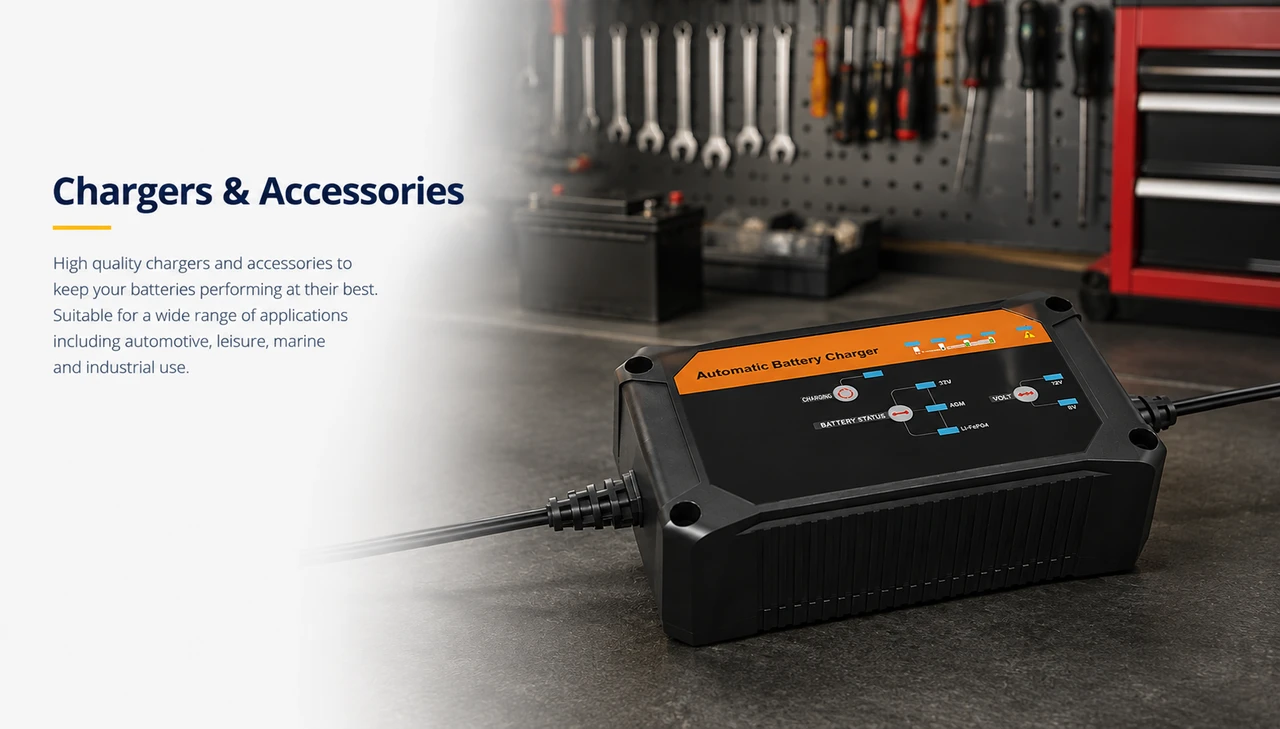
High-quality chargers and accessories to keep your batteries performing at their best. Suitable for a wide range of applications including automotive, leisure, marine and industrial use.
There are no products listed under this category.