
Motorhome & Campervan Battery Buying Guide
How to Choose a Motorhome or Campervan Leisure Battery
Choosing a leisure battery does not need to be complicated. The important questions are whether the battery will physically fit, how much capacity you need, how often you use it, whether your charging system suits the battery technology and whether your application needs unusually high temporary current — such as a caravan motor mover.
Just Tell Me Which Leisure Battery to Choose
Pick the option that sounds most like you and jump straight to our recommendation.
- Voltage: most motorhome, campervan and caravan leisure systems use 12V batteries.
- Dimensions: measure length, width and height of the available battery space.
- Capacity: check the Ah rating of the existing battery and consider whether you need more runtime.
- Technology: flooded, AGM and lithium offer very different price and performance levels.
- Terminals: check terminal position, connection type and cable reach.
- Charging: make sure your charger is suitable for the technology you choose.
Replacing an Existing Leisure Battery
If your motorhome, campervan or caravan already has a leisure battery fitted, you do not necessarily need the exact same brand or model. What matters is matching the important electrical and physical characteristics.
1. Check the Voltage
Most leisure systems use 12V batteries. Always confirm the system voltage, particularly where several batteries are installed.
2. Check the Ah Rating
A similar Ah rating is the easiest replacement, but moving to a higher capacity can provide more runtime if the larger battery fits and your charging system is suitable.
3. Measure the Battery
Batteries with similar capacities can use very different case sizes. Measure length, width and total height rather than choosing by Ah alone.
4. Check the Technology
Replacing like-for-like is the safest route, but you do not have to stay with flooded technology. AGM can offer a substantial upgrade without moving into lithium pricing.
Physical fit is especially important where the battery sits beneath a seat, inside furniture or in a dedicated battery enclosure.
↑ Back to quick recommendationsWhat Size Leisure Battery Do I Need?
The correct battery size means both physical size and electrical capacity. The battery must fit safely in the available space while storing enough energy for the time you expect to spend between charges.
Understanding Battery Capacity
Battery capacity is measured in amp-hours (Ah). A higher Ah rating generally means more stored energy and therefore more runtime between charges.
Typical leisure loads include lighting, water pumps, televisions, USB charging, heating controls, refrigeration equipment, control systems and inverters.
Energy used in Ah ≈ current draw in amps × hours of use
Estimate the consumption of the equipment you use between charges and add it together. This gives you a useful starting point for choosing capacity.
Can I Replace a 100Ah Battery With a 110Ah or 130Ah Battery?
Usually, yes. A higher Ah rating gives you a larger energy reserve; it does not force additional current into your appliances. Connected equipment only draws the current it requires.
Before increasing capacity, check:
- The replacement remains the correct voltage.
- The battery fits the available length, width and height.
- The mounting arrangement can support the battery weight.
- The terminals suit the existing cables.
- The charging system is suitable for the chosen technology.
- Your charger can adequately replenish the increased capacity.
Flooded vs AGM vs Lithium: What Are You Actually Paying For?
There is no reason to pay more for a battery unless the additional cost gives you something useful. In our leisure range, the main upgrade differences are particularly clear when comparing cycle life, construction, usable energy and weight.
| Technology | Cycle Capability | What You Gain | Our View |
|---|---|---|---|
| SFL Flooded | 300+ cycles | Lowest upfront cost, proven conventional technology and straightforward charging requirements. | Best when budget, basic charging compatibility or a simple like-for-like flooded replacement is the priority. |
| LAGM / XR AGM | 600+ cycles | Approximately twice the rated cycle capability of the SFL range, plus sealed and maintenance-free AGM construction. | Our recommendation for most regular leisure users. |
| LiFePO4 Lithium | 5,000 cycles | Dramatically greater cycle life, much lower weight and substantially greater usable capacity. | Best suited to frequent use, demanding off-grid systems and customers prioritising long-term performance. |
Cycle life depends on depth of discharge, temperature, charging regime and test conditions. The figures above are useful for comparing the relative design capability of each technology rather than guaranteeing an exact number of years in service.
Low-Profile 110Ah Batteries: Flooded or AGM?
Low-profile batteries are particularly useful where height is restricted beneath a seat or inside a dedicated caravan, campervan or motorhome battery compartment.
If both batteries are compatible with your installation, this is one of the clearest upgrade decisions in the range.
Leoch SFL-110LL
A good conventional leisure battery where keeping the initial purchase cost as low as possible is the main priority.
Leoch LAGM-110LL
For most regular leisure users, this is the option we would choose. It retains almost exactly the same low-profile footprint while moving to sealed AGM construction and approximately doubling rated cycle capability.
Why we recommend the upgrade: the LAGM-110LL costs only £36.43 more while offering roughly twice the rated cycle capability, sealed maintenance-free AGM construction and virtually the same low-profile dimensions. Unless keeping the initial spend as low as possible is the deciding factor, AGM is the stronger proposition.
110Ah vs 130Ah Leisure Batteries
If your battery compartment has enough room, moving from approximately 100–110Ah to 130Ah provides a useful increase in nominal energy storage. The main issue is normally physical size rather than electrical compatibility.
110Ah Low Profile
The SFL-110LL and LAGM-110LL are approximately 175mm high, making them particularly useful where vertical space is restricted.
130Ah Higher Capacity
130Ah provides a larger stored-energy reserve, but the batteries are taller and heavier. Measure the battery compartment before ordering.
130Ah Flooded vs AGM
Leoch SFL-130DT
A cost-effective high-capacity flooded battery with dual terminals for installations requiring flexible connections.
Leoch LAGM-130
Our preferred 130Ah option for regular leisure use. It combines increased capacity with sealed AGM construction and approximately twice the rated cycle capability of the SFL flooded range.
Our view: if the LAGM-130 fits your installation and your charger is suitable for AGM, the price gap is small enough that AGM will usually be our recommendation for regular use.
Best Battery for a Caravan Motor Mover
A caravan motor mover demands something different from a battery than ordinary leisure equipment. Lighting, pumps and control systems generally use relatively modest current, while a motor mover can demand a large temporary current while physically moving the caravan.
That means choosing purely by Ah capacity can miss an important part of the requirement.
Leoch XR-1750DC 12V 110Ah Xtreme AGM
The XR-1750DC is our preferred option in this case size where the battery needs to combine normal leisure cycling with strong temporary current delivery.
Its dual-purpose starter/leisure construction is the key difference. It is capable of repeated leisure cycling while also being designed to provide the type of short-duration high current associated with starting and other demanding loads.
For a caravan fitted with a motor mover, that makes the XR-1750DC a particularly logical choice rather than simply selecting a battery based on capacity alone.
- 600+ cycle capability for regular leisure use.
- Dual-purpose AGM construction for cyclic and high-current performance.
- High temporary current capability suited to demanding short-duration loads.
- Sealed and maintenance-free AGM construction.
- Strong vibration resistance for mobile applications.
Should I Choose Flooded or AGM?
For most customers choosing from our leisure range, AGM is our recommendation where the additional purchase cost is affordable and the existing charging system is suitable.
Flooded remains a perfectly valid option, but the reasons for choosing it are usually fairly specific:
- You need the lowest possible upfront purchase price.
- You want a straightforward like-for-like flooded replacement.
- You have an older or very basic charging arrangement and prefer to stay with conventional flooded technology.
Outside of those situations, the move from approximately 300+ to 600+ cycle capability for a relatively modest price increase makes AGM difficult to ignore for regular leisure use.
If flooded solves a budget or compatibility problem, buy flooded. If it does not, we would normally spend the extra and choose AGM.
Should I Upgrade to Lithium?
Lithium is a much larger technological step than moving from flooded to AGM. It becomes particularly attractive for customers who use their leisure system heavily, spend substantial time off-grid, want to reduce vehicle weight or want maximum long-term cycle capability.
Lithium is not simply about a bigger cycle-life number. At approximately 10kg, this battery also removes a considerable amount of weight compared with equivalent lead-acid leisure batteries, while LiFePO4 technology allows a much greater proportion of the battery's stored capacity to be used.
Add integrated battery management, Bluetooth monitoring and automatic self-heating, and it becomes a very different proposition for frequent touring or demanding off-grid use.
Check the mains charger, solar charge controller and alternator charging arrangement. Depending on the vehicle, a lithium-compatible charger or DC-DC charging system may be required.
Will My Existing Charger Work With a New Leisure Battery?
Battery technology and charging system need to work together. If you are replacing a battery with the same technology, the existing charger may already be suitable. If you are upgrading technology, check before ordering.
Flooded → Flooded
Usually the most straightforward replacement where voltage, capacity and physical fit remain suitable.
Flooded → AGM
Check that your charger provides a suitable AGM charging profile and voltage. Many modern smart chargers can support both technologies.
Lead-Acid → Lithium
Check every charging source including mains charging, solar charging and alternator charging before converting.
Using Two or More Leisure Batteries
Multiple 12V leisure batteries can be connected in parallel to increase total Ah capacity while keeping the system at 12V. For example, two correctly connected 100Ah 12V batteries provide approximately 200Ah of nominal capacity at 12V.
For best performance, batteries operating together should ideally be the same model, technology, capacity and similar age.
If several batteries have been used together for the same period, replacing the complete matched set is generally preferable to adding one brand-new battery alongside significantly older batteries.
Motorhome, Campervan & Caravan Leisure Battery FAQs
These are some of the questions we are most commonly asked when customers are deciding which leisure battery to buy.
Is AGM worth the extra cost over flooded?
For most regular leisure users, we think so. Our SFL flooded range offers approximately 300+ cycle capability while the LAGM and XR AGM options offer approximately 600+ cycles. Where the price difference is relatively small and the charger is compatible, AGM is usually our preferred choice.
Why would I still choose a flooded leisure battery?
Flooded makes the most sense when you need the lowest possible initial purchase price, want a straightforward like-for-like flooded replacement or have a basic charging setup where remaining with conventional flooded technology is the safest option.
Can I replace a 100Ah leisure battery with a 110Ah or 130Ah battery?
In many cases, yes. The replacement must remain the correct voltage, physically fit the battery compartment, use a suitable terminal arrangement and be compatible with the charging system. Increasing Ah gives you a larger energy reserve; it does not force additional current into your equipment.
What battery is best for a caravan motor mover?
A motor mover benefits from a battery that can supply strong temporary current as well as support normal leisure cycling. Our preferred option in this case size is the Leoch XR-1750DC because its dual-purpose AGM construction is designed for both deep-cycle use and high-current demand.
Can I use a normal car starter battery as a leisure battery?
A conventional starter battery is not normally the best choice for repeated leisure cycling. Starter batteries are primarily designed to provide short bursts of high current, whereas leisure batteries are designed to tolerate repeated discharge and recharge cycles. A dual-purpose battery such as the XR-1750DC is more suitable where both characteristics are required.
How long will a 100Ah leisure battery last?
Runtime depends on electrical load, battery technology and usable capacity. As a simple example, a continuous 5A load would theoretically consume 50Ah over 10 hours. Real-world performance varies according to temperature, discharge rate, battery condition and the depth to which the battery is discharged.
Should I replace both leisure batteries at the same time?
If two batteries have operated together as a matched bank and are of similar age, replacing both together is usually preferable to mixing a new battery with a significantly older one.
Can I mix AGM and flooded leisure batteries?
We generally recommend keeping batteries within the same bank matched by technology, capacity, model and age wherever possible. AGM and flooded batteries can have different charging and operating characteristics.
Can solar panels charge a motorhome or campervan leisure battery?
Yes. Solar panels can recharge a leisure battery through a suitable solar charge controller. The controller should be configured correctly for the battery technology being used.
Does the alternator charge the leisure battery while driving?
Many motorhomes and campervans recharge the leisure battery while the engine is running. The system may use a split-charge relay, battery-to-battery charger or DC-DC charger depending on the vehicle and electrical installation.
Can I upgrade from flooded straight to AGM?
Often, yes. Check that the AGM battery physically fits, has the correct terminal arrangement and that your charging equipment provides a suitable charging profile. If those conditions are met, AGM can be a straightforward and worthwhile upgrade.
Can I upgrade from AGM to lithium?
Yes, but lithium requires more attention to charging compatibility. Check the mains charger, solar controller and alternator charging system before converting, as lithium-compatible charging equipment or a DC-DC charger may be required.
Still Not Sure Which Leisure Battery You Need?
You do not need to become a battery expert before ordering. If you are unsure, our UK battery team can help identify the closest replacement or recommend a worthwhile upgrade.
- A clear photograph of the existing battery label.
- The battery make and model if visible.
- The battery length, width and height.
- Your motorhome, campervan or caravan make and model.
- Whether the battery powers a caravan motor mover.
- How you normally use the vehicle, including how often you stay off-grid.
- Whether you want the cheapest suitable replacement or are open to AGM or lithium upgrades.
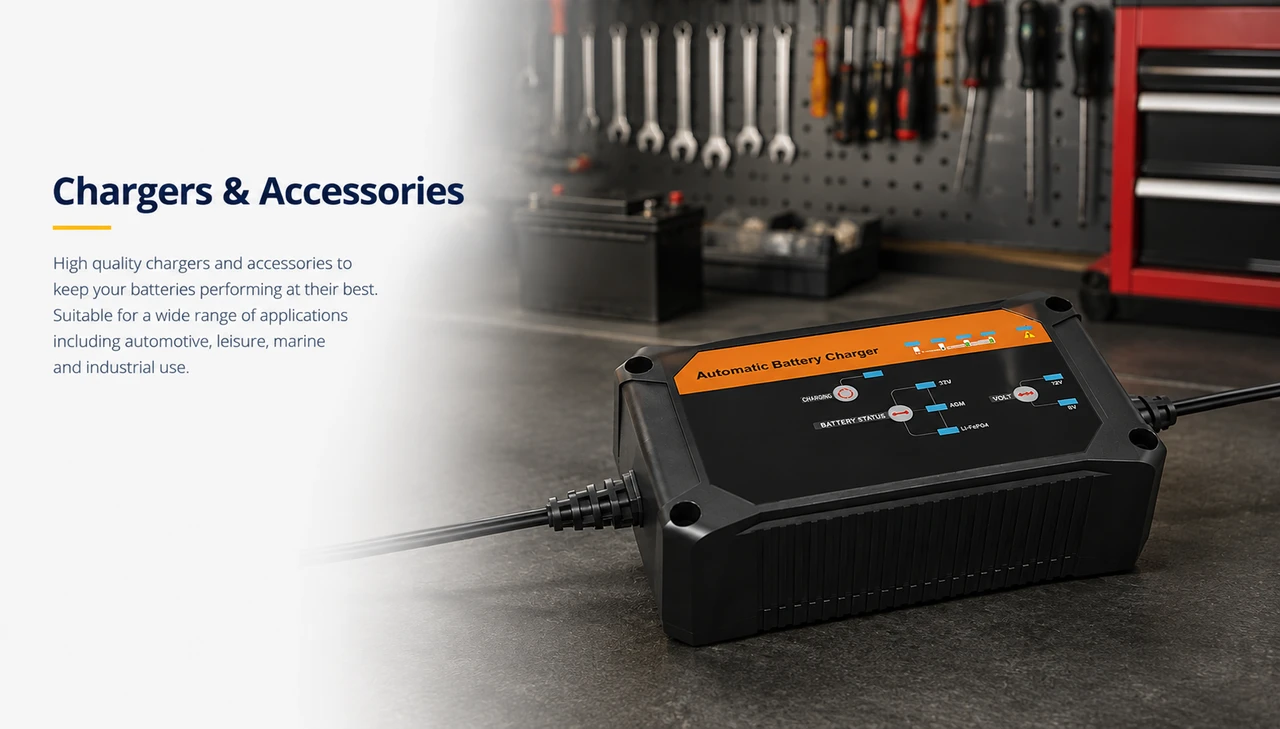
Chargers & Accessories
High-quality chargers and accessories to keep your batteries performing at their best. Suitable for a wide range of applications including automotive, leisure, marine and industrial use.
There are no products listed under this category.